
StarEdge / Edge AI Research
StarEdge Edge AI Nodes
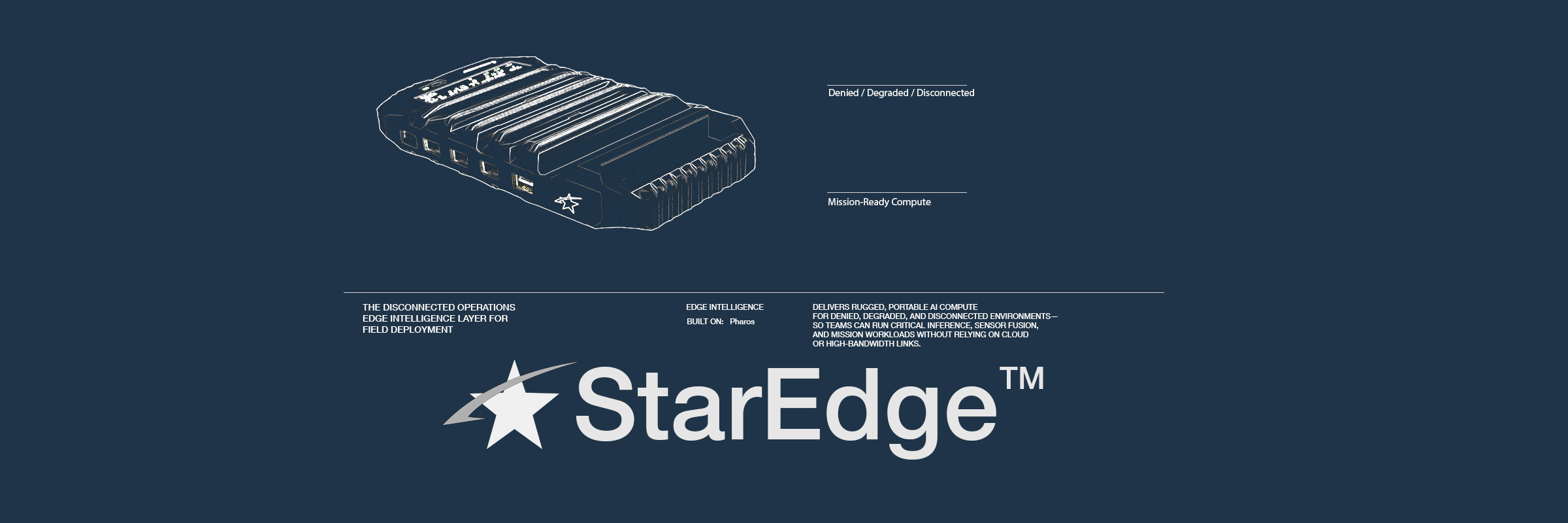
StarEdge is Rendeer Systems' edge AI research line for portable, rugged compute in disconnected environments. StarEdge prototypes explore compact nodes that ingest detections, tracks, and telemetry from unmanned platforms and local sensors, run heavier perception and fusion workloads at the edge, and maintain a coherent view of the environment without depending on continuous cloud connectivity.
Multi-Asset Fusion & Coordination
StarEdge prototypes combine detections, tracks, and state estimates from multiple Pharos-instrumented platforms and other sensors into a single, coherent view of the environment. Air and surface assets contribute their own perspectives, while StarEdge resolves overlap and ambiguity over time to maintain a fused picture.
Links between platforms and StarEdge are assumed to be imperfect. Experiments focus on prioritizing and compressing updates so that missions can continue under intermittent or contested RF conditions, with assets resynchronizing when connectivity returns. The goal is to let operators focus on intent and effects rather than low-level link management.
Fleet & Node Management Concepts
StarEdge is also a testbed for how edge nodes and autonomy modules might be managed as a fleet. Research prototypes explore cloud or hub-based control planes that provide configuration, software updates, and health monitoring for distributed nodes and connected platforms, while keeping mission-critical autonomy and sensing at the edge.
Over time, this work is aimed at letting operators treat edge nodes and Pharos-based systems as a single, managed resource: provisioning new sites, rolling out updated models, and enforcing policy across air and surface assets without having to manually touch each system in the field.
Form factor and power
StarEdge concepts focus on man-portable, backpack- and vehicle-mounted edge nodes for forward teams, shelters, or small command posts. Design goals include compact, flat footprints for stowing in standard packs and tight spaces, internal batteries that provide ride-through operation, and docking or cradle options that supply continuous power and optional range-extender packs for longer missions.
Hardware experiments emphasize thermal behavior and power envelopes suitable for sustained AI workloads at the edge rather than datacenter conditions, using modern embedded compute modules and accelerators as they evolve.
I/O and radios
StarEdge nodes are designed to talk to air and surface platforms as well as local operators. Typical configurations under study include Ethernet and serial interfaces for direct links to ground stations and radios, with options to integrate existing RF systems and sensor networks. StarEdge can aggregate multiple links, prioritize traffic, and bridge between different networks so platforms and operators see a consistent picture even as individual links change.
Deployment environments
StarEdge is intended for contested, bandwidth-limited environments rather than climate-controlled datacenters. Enclosure and system designs target MIL-STD-inspired environmental and EMC performance and are aimed at field ISR, cross-domain data movement, and safety-critical industrial analytics where compact size, battery ride-through, and strict separation between domains and sites are essential.
As with Pharos, this work is exploratory. StarEdge hardware and software prototypes are internal R&D tools and reference designs and are not presented as finalized, commercial products.